With $20
$1 units cover 5 losses ($15), then $6 is needed with $5 left. In our test, $20 grew to $30 in 56.9% of sessions, the best of any system.
D'Alembert strategy guide · Updated October 2026
The D'Alembert system adds one unit to your bet after a loss and takes one off after a win. It's the gentlest of the popular progressions. Enter your unit and bankroll to see how far a losing run can go, where one win leaves you, and how often 10,000 D'Alembert sessions reach your goal.
With $1 units and $100, D'Alembert covers 13 losses in a row, against 9 for Fibonacci and 6 for Martingale. In our test it reached $150 in 52.8% of sessions, more often than either, but it lost more on average because it bets more in total.
We earn a commission if you sign up through our casino links. It doesn't change the numbers: every figure on this page is calculated or simulated from the wheel's real odds.
See how far a losing run goes, where one win leaves you, and how often 10,000 sessions reach your goal. Change any number and it updates.
Bets on red or black. The losing-run figures are exact; the session odds come from 10,000 sessions played in your browser, up to 1,000 spins each.
With $100 and $1 units, D'Alembert covers 13 losses in a row ($91). Bet 14 would be $14, with $9 left.
Gold: D'Alembert's bets. Gray: what Martingale would bet. Red: the bet you can't place. Tap a bar for details.
| Bet | Stake | Total lost | Win here | Next bet |
|---|---|---|---|---|
| 1 | $1 | $1 | +$1 | $1 |
| 2 | $2 | $3 | +$1 | $1 |
| 3 | $3 | $6 | Level | $2 |
| 4 | $4 | $10 | −$2 | $3 |
| 5 | $5 | $15 | −$5 | $4 |
| 6 | $6 | $21 | −$9 | $5 |
| 7 | $7 | $28 | −$14 | $6 |
| 8 | $8 | $36 | −$20 | $7 |
| 9 | $9 | $45 | −$27 | $8 |
| 10 | $10 | $55 | −$35 | $9 |
| 11 | $11 | $66 | −$44 | $10 |
| 12 | $12 | $78 | −$54 | $11 |
| 13 | $13 | $91 | −$65 | $12 |
| 14 | $14 | Can't place it: $9 left | ||
With $1 units. Total lost: if this bet loses too. Win here: where the run stands if this bet wins, and the next bet.
In our test, the biggest single bet was $21. Every dollar bet on a European wheel loses 2.70 cents on average, whatever the progression.
Tables that fit your D'Alembert
Single-zero live tables that take a $1 bet and go up to at least $13, so your bankroll runs out before the table limit does.
 MyBookie12 of 13 tables fit · $0.10 to $10,000
Play now
MyBookie12 of 13 tables fit · $0.10 to $10,000
Play now
 Wild Casino6 of 11 tables fit · $0.50 to $12,500
Play now
Wild Casino6 of 11 tables fit · $0.50 to $12,500
Play now
 BetUSAll 3 tables fit · $0.50 to $12,500
Play now
BetUSAll 3 tables fit · $0.50 to $12,500
Play now
From the limits posted on each casino's live tables, checked October 2026. The limit on red or black can be lower than the table maximum. Compare limits at 8 sites
The rules
D'Alembert is a negative progression: your bet goes up after a loss. But it climbs one unit at a time, not by doubling like Martingale or along a sequence like Fibonacci. You play it on even-money bets, such as red, black, odd, even, 1–18 or 19–36, where a win pays what you bet.
The thinking behind it is that wins and losses even out. When they do, D'Alembert finishes ahead, because your winning bets tend to be the bigger ones. When they don't, which on a roulette wheel is most of the time over the long run, the extra losses cost more than the system makes back.
Pick a unit, usually the table minimum, and bet it on an even-money bet.
After a loss, your next bet is one unit more: 1, 2, 3, 4, 5 units, and so on.
After a win, bet one unit less, but never less than one. Win at 4 units and your next bet is 3.
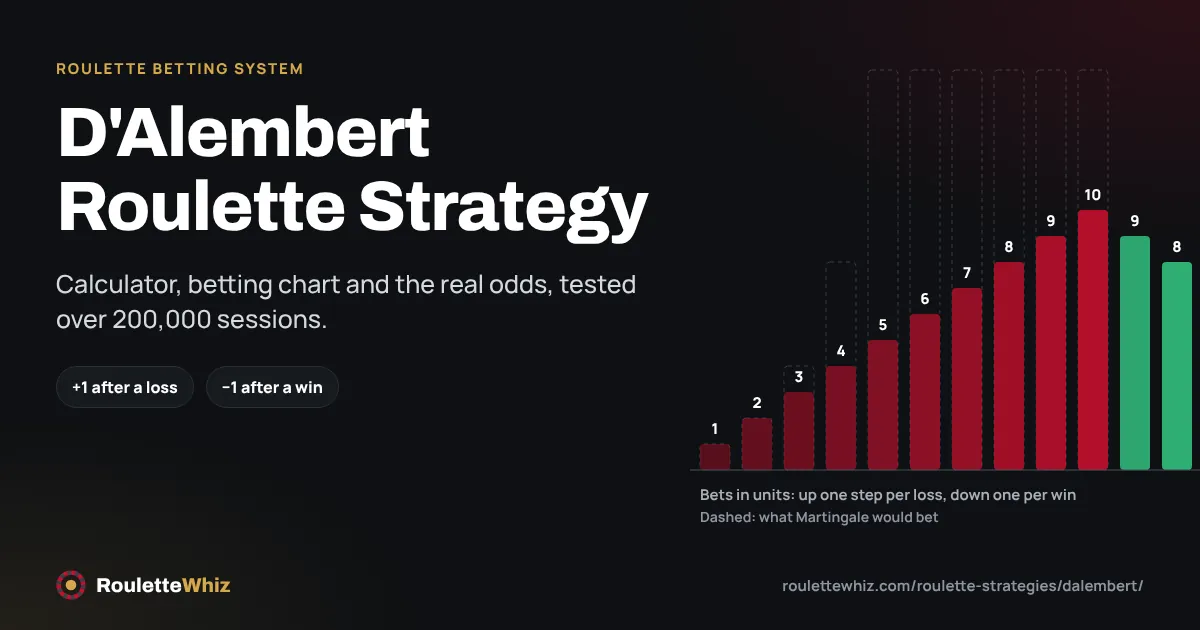
Bets in units on an even-money bet: up one after a loss, down one after a win, never below 1. Five wins and five losses still end ahead, because the winning bets were the bigger ones.
Three losses, then two wins. Watch the running total.
Three losses cost $6. The $4 win gets you back to $2 down, the $3 win puts you $1 ahead, and your next bet is $2. Two wins cleared three losses, because each winning bet was bigger than the losses before it. Lose the 4th bet instead and you'd be $10 down with $5 to bet next.
D'Alembert chart
Every bet in a losing run with $1 and $5 units, what one win at that bet leaves you with, and the chance of losing that many in a row on red.
| Bet | $1 units: stake | $1 units: total lost | $5 units: stake | If this bet wins | Chance this bet loses too |
|---|---|---|---|---|---|
| 1 | $1 | $1 | $5 | +1 unit, next bet 1 | 51.4% (1 in 2) |
| 2 | $2 | $3 | $10 | +1 unit, next bet 1 | 26.4% (1 in 4) |
| 3 | $3 | $6 | $15 | Level, next bet 2 | 13.5% (1 in 7) |
| 4 | $4 | $10 | $20 | −2 units, next bet 3 | 7.0% (1 in 14) |
| 5 | $5 | $15 | $25 | −5 units, next bet 4 | 3.6% (1 in 28) |
| 6 | $6 | $21 | $30 | −9 units, next bet 5 | 1.8% (1 in 55) |
| 7 | $7 | $28 | $35 | −14 units, next bet 6 | 0.94% (1 in 106) |
| 8 | $8 | $36 | $40 | −20 units, next bet 7 | 0.48% (1 in 207) |
| 9 | $9 | $45 | $45 | −27 units, next bet 8 | 0.25% (1 in 403) |
| 10 | $10 | $55 | $50 | −35 units, next bet 9 | 0.13% (1 in 784) |
| 11 | $11 | $66 | $55 | −44 units, next bet 10 | 0.065% (1 in 1,527) |
| 12 | $12 | $78 | $60 | −54 units, next bet 11 | 0.034% (1 in 2,974) |
| 13 | $13 | $91 | $65 | −65 units, next bet 12 | 0.017% (1 in 5,792) |
| 14 | $14 | $105 | $70 | −77 units, next bet 13 | 0.009% (1 in 11,279) |
| 15 | $15 | $120 | $75 | −90 units, next bet 14 | 0.005% (1 in 21,965) |
"If this bet wins" assumes every bet before it lost. "Chance this bet loses too" is the chance of losing that many in a row from the start, on a European wheel (19 losing pockets out of 37).
After n losses in a row you've bet 1 + 2 + … + n units: n × (n + 1) ÷ 2. Ten losses cost 55 units, and the next bet is 11. With Martingale, the same run costs 1,023 units.
Each loss adds only one unit to the next bet, so even a 15-loss run needs a 16-unit bet. The total keeps building, though: 120 units after 15 losses, more than a $100 bankroll with $1 units.
The big idea
The system is named after Jean le Rond d'Alembert, an 18th-century French mathematician who doubted that coin tosses were truly independent. Gamblers took that as permission to believe results balance out: after a run of losses, wins are "due". D'Alembert's bet sizing is built on that belief.
Here's the part that's true. If your wins and losses do come out even, D'Alembert usually ends ahead. We checked every possible order of 10 wins and 10 losses, all 184,756 of them, and the results below show why the idea is so convincing, and why it fails.
10 wins, 10 losses
79.0%of orders finish ahead, by 5 units on average. Another 12.6% finish level.
9 wins, 11 losses
−0.07units on average. One extra loss in 20 spins wipes out the whole advantage.
What the wheel gives
48.6%chance of winning an even-money bet. Over 20 spins you can expect about 9.7 wins and 10.3 losses.
Every order of the wins and losses counted equally, $1 units, starting at one unit. The wheel has no memory: a run of losses doesn't make a win more likely.
Head to head
The same losing run, three systems, $1 units. D'Alembert adds a unit, Fibonacci follows its sequence, Martingale doubles.
4 losses in a row
6 losses in a row
8 losses in a row
10 losses in a row
$1 units on an even-money bet. Each group is drawn to its own scale.
| Losses in a row | D'Alembert: lost / next bet | Fibonacci: lost / next bet | Martingale: lost / next bet |
|---|---|---|---|
| 3 | $6 / $4 | $4 / $3 | $7 / $8 |
| 5 | $15 / $6 | $12 / $8 | $31 / $32 |
| 7 | $28 / $8 | $33 / $21 | $127 / $128 |
| 10 | $55 / $11 | $143 / $89 | $1,023 / $1,024 |
| 13 | $91 / $14 | $609 / $377 | $8,191 / $8,192 |
| 15 | $120 / $16 | $1,596 / $987 | $32,767 / $32,768 |
| 20 | $210 / $21 | $17,710 / $10,946 | $1,048,575 / $1,048,576 |
D'Alembert reached $150
52.8%Average −$16.26 on $599 bet. Biggest bet $21.
Fibonacci reached $150
48.2%Average −$12.81 on $475 bet. Biggest bet $55.
Martingale reached $150
48.8%Average −$6.32 on $233 bet. Biggest bet $64.
200,000 sessions each: $100 bankroll, $1 units, European wheel, up to 1,000 spins. Divide each average by the total bet and you get 2.7% every time. Read the Martingale guide and the Fibonacci guide.
Bankroll
Losses in a row each bankroll covers before the next D'Alembert bet is more than you have left, ignoring table limits. Under each number: the chance of losing that many in a row on a European wheel.
| Bankroll | $1 units | $5 units | $10 units | $25 units |
|---|---|---|---|---|
| $20 | 53.6% | 226.4% | 151.4% | — |
| $50 | 90.25% | 47.0% | 226.4% | 151.4% |
| $100 | 130.017% | 53.6% | 47.0% | 226.4% |
| $200 | 19under 0.001% | 80.48% | 53.6% | 313.5% |
| $500 | 31under 0.001% | 130.017% | 90.25% | 53.6% |
| $1,000 | 44under 0.001% | 19under 0.001% | 130.017% | 80.48% |
| $5,000 | 60under 0.001% | 44under 0.001% | 31under 0.001% | 19under 0.001% |
| $10,000 | 60under 0.001% | 60under 0.001% | 44under 0.001% | 27under 0.001% |
With D'Alembert, a mixed run of wins and losses can push your bets up too, because a win only takes one unit off. Losses in a row are the simplest way to see how much room you have.
$1 units cover 5 losses ($15), then $6 is needed with $5 left. In our test, $20 grew to $30 in 56.9% of sessions, the best of any system.
$1 units cover 9 losses ($45), then $10 is needed with $5 left. $50 grew to $75 in 55.4% of our test sessions.
$1 units cover 13 losses ($91), then $14 is needed with $9 left. $100 grew to $150 in 52.8% of sessions.
$1 units cover 19 losses ($190), then $20 is needed with $10 left. With a bigger goal to reach, $200 grew to $300 in 48.7% of sessions.
Table limits
D'Alembert bets grow so slowly that the table maximum almost never stops you; the minimum matters more, because it sets your unit. For each casino, the single-zero live table that takes your unit with the highest limit, and how many losses in a row it allows.
| Casino | Widest single-zero table | $1 units: losses covered | $5 units: losses covered | $25 units: losses covered | Play |
|---|---|---|---|---|---|
| MyBookie | $0.10 to $10,000 | 60last bet $60 | 60last bet $300 | 60last bet $1,500 | Play |
| Wild Casino | $0.50 to $12,500 | 60last bet $60 | 60last bet $300 | 60last bet $1,500 | Play |
| BetUS | $0.50 to $12,500 | 60last bet $60 | 60last bet $300 | 60last bet $1,500 | Play |
| BetOnline | $0.50 to $12,500 | 60last bet $60 | 60last bet $300 | 60last bet $1,500 | Play |
| Ignition | $10 to $3,000 | 60last bet $60 | 60last bet $300 | 60last bet $1,500 | Play |
| The Online Casino | $1 to $10,000 | 60last bet $60 | 60last bet $300 | 60last bet $1,500 | Play |
| Cafe Casino | $10 to $3,000 | 60last bet $60 | 60last bet $300 | 60last bet $1,500 | Play |
| DuckyLuck | $0.50 to $6,000 | 60last bet $60 | 60last bet $300 | 60last bet $1,500 | Play |
From the limits posted on each casino's live tables, checked October 2026. "—" means no single-zero table we saw takes that unit. Numbers this high mean your bankroll, not the table, sets the limit.
Best table for D'AlembertA low minimum. MyBookie has live tables from $0.10, so you can play D'Alembert with 10-cent units: $10 then covers 13 losses in a row, the same as $100 with $1 units.
Play at MyBookieRecovery
Each win is a bigger bet than the loss before it, so a streak of wins clears a run faster than you'd expect. Here's how many wins in a row it takes to get back ahead, and how likely that streak is on red.
| Losses in a row | Units down | Wins in a row to get ahead | Units ahead after them | Chance of that many wins in a row |
|---|---|---|---|---|
| 3 | 6 | 2 | +1 | 23.7% |
| 4 | 10 | 3 | +2 | 11.5% |
| 5 | 15 | 4 | +3 | 5.6% |
| 6 | 21 | 4 | +1 | 5.6% |
| 8 | 36 | 6 | +3 | 1.3% |
| 10 | 55 | 7 | +1 | 0.64% |
| 12 | 78 | 9 | +3 | 0.15% |
| 15 | 120 | 11 | +1 | 0.036% |
Wins don't have to come in a row, but each loss in between pushes your bet back up a unit and adds to what you need to win back.
The honest answer
Not as a way to beat roulette. D'Alembert hit its goal more often than Martingale or Fibonacci in our test, but it also bet more in total than either, and every dollar bet loses 2.70 cents on average on a European wheel.
What D'Alembert does well is keep your bets small and your sessions calm. If you want a system that rarely asks for a big bet, it's the best of the classic progressions. Just don't confuse a high win rate with a profit.
$1 units, European wheel, from 200,000 sessions in our strategy simulator.
French with La Partage
58.3%reached $150. Average result −$7.91 per session.
European
52.8%reached $150. Average result −$16.26 per session.
American
41.9%reached $150. Average result −$31.86 per session.
200,000 sessions per wheel: $100 bankroll, $1 units, up to 1,000 spins, $5,000 table maximum. None of the sites we list has a French table, so European is the best wheel you'll find there.
Variations
Raise after wins
Also called Contra D'Alembert: one unit up after a win, one down after a loss. Bets grow in winning streaks, and a losing run costs one unit a spin.
Compare with ParoliFaster steps
Raise by two or three units after a loss instead of one. Runs clear sooner, but the bets climb faster and you're closer to Fibonacci territory.
How Fibonacci comparesStop-loss
Pick a top bet, say 10 units, and reset to one unit when you'd go past it. You give up the recovery but cap what one run can cost.
Set a table max in the calculatorBigger risk
The opposite end of the scale: double after every loss so one win clears the run. It wins more sessions quickly and loses bigger when it fails.
Martingale calculatorBefore you play
None of these beat the house edge. They help you play a slow, steady system without letting it run too long.
D'Alembert bets stay small, so the unit is what decides your risk. A $1 unit with $100 covers 13 losses in a row.
D'Alembert reached its goal in 52.8% of our test sessions on a European wheel and 41.9% on an American one.
It's easy to lose track after a mixed run. Your next bet is always your last bet, plus one after a loss or minus one after a win.
A long losing run moves slowly with D'Alembert, which makes it tempting to keep going. Decide the most you'll lose before you start.
D'Alembert wins a little at a time. A goal of 25% to 50% of your bankroll, then leaving, keeps the house edge from catching up.
The system assumes wins and losses balance. On an even-money bet they don't: 18 pockets win and 19 lose.
Many bonuses exclude roulette or ban progressive betting patterns, which can void the bonus and its winnings.
Play a few sessions with free chips in our roulette simulator before you use the system with real money.
Real money
D'Alembert needs a low minimum more than a high maximum, because your unit decides how many losses you can cover. These sites post the limits on their live tables. Pick a European wheel: none of them has a French table with La Partage.
MyBookie
Single-zero tables from $0.10 to $10,000
200% up to $2,000
Read our MyBookie review
Play now
Wild Casino
Single-zero tables from $0.50 to $12,500
250 Free Spins
Read our Wild Casino review
Play now
Affiliate links: we may earn a commission if you sign up through these buttons. They open real money casinos, not our free tools. Ranked as on our best online roulette sites list; compare all 10 in our roulette site reviews.
A betting system where you add one unit to your bet after a loss and take one unit off after a win, never going below one unit. It's played on even-money bets such as red or black, and it's named after the 18th-century French mathematician Jean le Rond d'Alembert.
It can win small sessions often, but not in the long run. In our test, D'Alembert turned $100 into $150 in 52.8% of sessions on a European wheel, the sessions that ran short lost $92 on average, and the average result was −$16.26. Every dollar bet still lost 2.70 cents.
Its bets climb much more slowly: after 8 losses in a row D'Alembert bets 9 units, Fibonacci 34 and Martingale 256. That makes a losing run cheaper and table limits almost irrelevant. But a win doesn't clear the run, so sessions last longer. In our test D'Alembert reached its goal in 52.8% of sessions, Martingale in 48.8%.
Usually you end up ahead. In every possible order of 10 wins and 10 losses, D'Alembert finishes ahead 79% of the time and 5 units up on average, because the winning bets tend to be the bigger ones. But even-money bets win only 48.6% of spins, so over time losses outnumber wins, and one extra loss in 20 spins wipes out that average.
Less than for Martingale or Fibonacci to survive the same run. With $1 units, 10 losses in a row cost $55 and 13 cost $91. A $100 bankroll covers 13 losses in a row before the next bet ($14) is more than you have left.
Also called the Contra D'Alembert: you add a unit after a win and take one off after a loss, so your bets rise during winning streaks. It risks less in a losing run, but it doesn't change the house edge.
Fewer than you might think, if they come together, because each win is a bigger bet than the last loss. After 6 losses (21 units down) it takes 4 wins in a row to get back ahead; after 10 losses (55 units down) it takes 7.
French with La Partage, then European. In our test D'Alembert reached its goal in 58.3% of sessions on a French wheel, 52.8% on a European wheel and 41.9% on an American wheel.
It's named after Jean le Rond d'Alembert, the French mathematician who also questioned whether coin tosses were truly independent. Gamblers turned that doubt into the idea that results "even out", which is the thinking behind the system. Modern probability says each spin is independent.
Yes. Use the calculator on this page to check your numbers, then play the system by hand with free chips in our roulette simulator. Free chips have no cash value.
The losing-run figures and charts are exact for the standard D'Alembert system on an even-money bet: one unit up after a loss, one unit down after a win, never below one. The equal-wins figures count every possible order of 10 wins and 10 losses (184,756 of them). The session odds come from the same engine as our strategy simulator: 200,000 sessions per result, $100 bankroll, $1 units, a $50 goal, up to 1,000 spins and a $5,000 table maximum, with zero losing in full except under La Partage. Table limits are from each casino's live lobby. Further reading: the D'Alembert system at Wizard of Odds and Random Services on roulette probabilities.
Set a budget before you start, never borrow to keep a progression going, and stop when it's gone. If gambling stops being fun, call 1-800-GAMBLER or visit ncpgambling.org for free, confidential help.