Roulette Payouts: Bets, Odds and Examples
Standard roulette payouts run from 35:1 for a single number to 1:1 for red or black. The ratio describes your profit on a winning bet, not the full amount returned. A winning $1 number bet returns $36: $35 profit plus your original chip.
The chart below covers the common bets, followed by exact chip positions and examples with several bets on the same spin. For real-money play, compare the table rules as well as the casino: an extra zero changes your chances even when the listed payouts stay the same. These three casinos are a starting point for comparing roulette games and stakes.
Play roulette for real money

Wild Casino
Software roulette and live dealer tables in one casino. Choose your own pace in a software game or follow the dealer’s betting rounds at a live table.
Visit Casino
BetUS
Ordinary Roulette, High Limit and High Roller versions, plus European and American tables. Check each game’s limits rather than assuming every version takes the same stakes.
Visit Casino
MyBookie
European and American roulette options in the table-game lobby. Compare the zero pockets and payout rules before choosing a table, especially when switching between versions.
Visit CasinoWe may earn a commission when you join through these links. Check account eligibility and the game’s rules before depositing.
Roulette payout chart
A bet covering fewer numbers pays more when it wins. The figures here apply to standard roulette payouts, not multiplier games or optional side bets. A $1 stake is used for the arithmetic; it is not a claim about any casino’s minimum bet.
| Bet | Numbers | Pays | $1 returns |
|---|---|---|---|
| Straight | 1 | 35:1 | $36 |
| Split | 2 | 17:1 | $18 |
| Street | 3 | 11:1 | $12 |
| Corner | 4 | 8:1 | $9 |
| Six line | 6 | 5:1 | $6 |
| Dozen | 12 | 2:1 | $3 |
| Column | 12 | 2:1 | $3 |
| Red or black | 18 | 1:1 | $2 |
| Odd or even | 18 | 1:1 | $2 |
| Low or high | 18 | 1:1 | $2 |
Zero combinations and the double-zero five-number bet are explained separately below. A winning return is not necessarily the profit for your whole round if you also placed losing bets.
35:1 is not the same label as 36× returned. Both can describe a winning straight bet: 35 units of profit plus the one unit staked. For a $5 chip, that is $175 profit and $180 returned.
Inside bets: where the chip goes
Inside bets sit on the number grid or its edge. A chip in a box, on a shared line and on an intersection makes three different bets. Neighbouring numbers on the betting layout are not necessarily neighbours around the wheel. For the sequence of a round, start with how to play roulette.
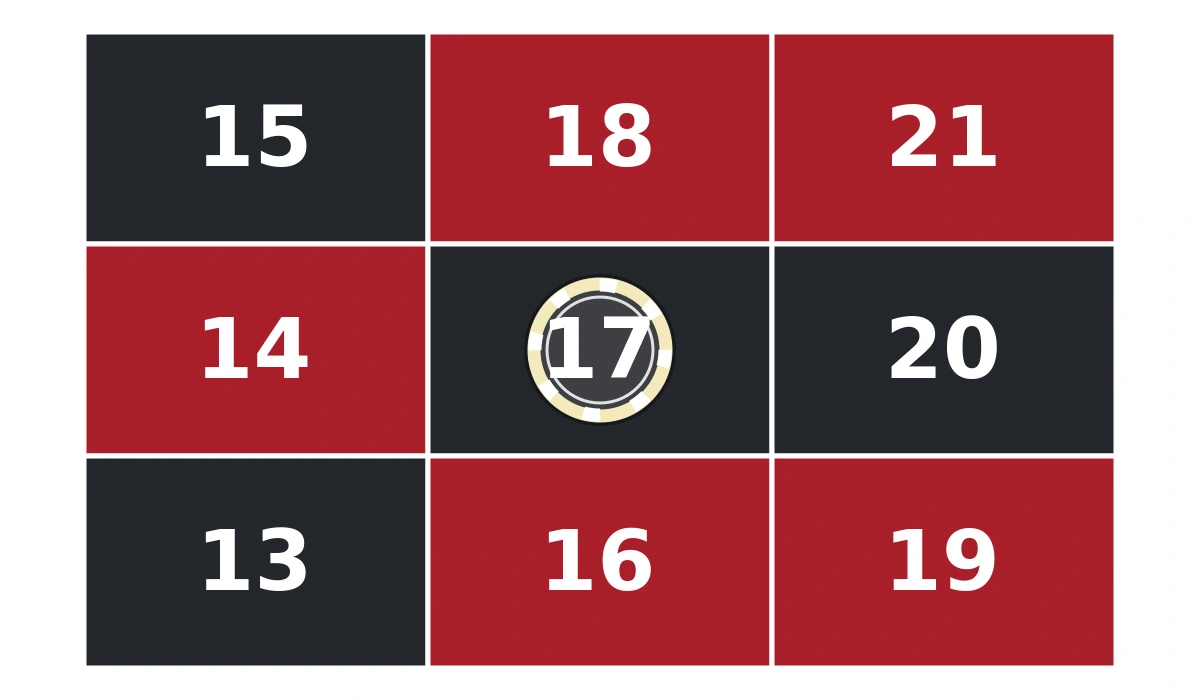
Straight: one number
Put the chip inside 17. Only 17 wins, paying 35:1. A $1 bet returns $36 when it hits; any other result loses that $1. A straight bet on zero has the same standard payout.
Covers 17. $1 winning return: $36.
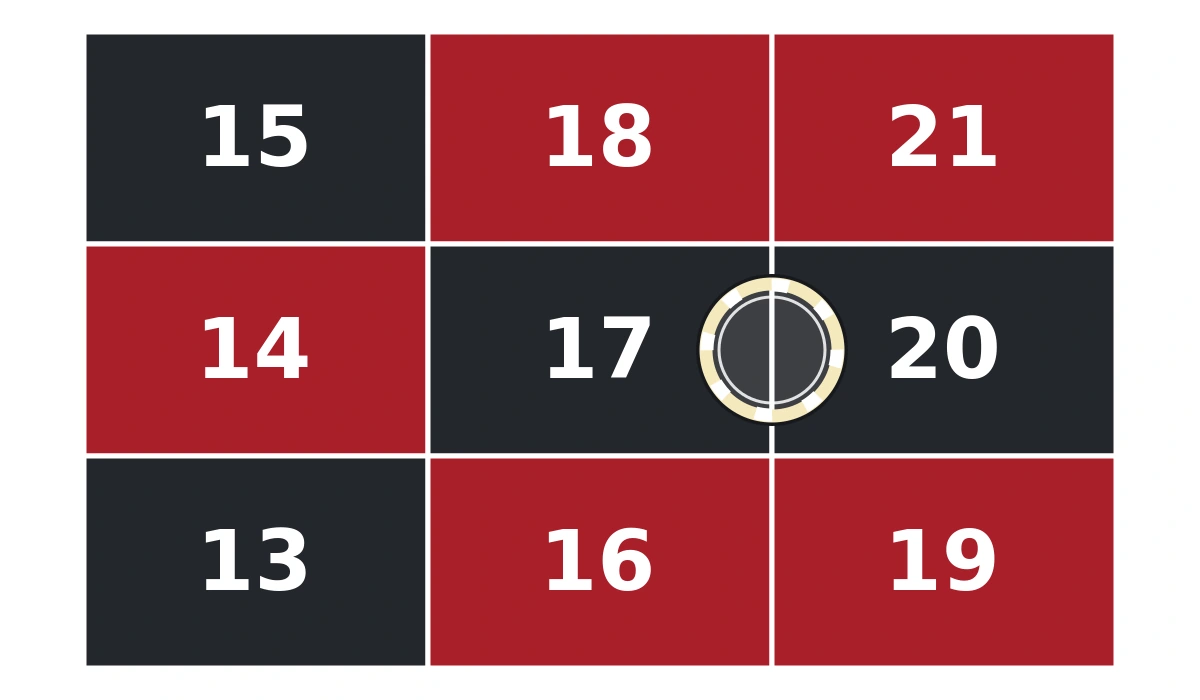
Split: two numbers
Place the chip on the line between 17 and 20. Either number wins the one bet at 17:1. A $1 split costs $1 in total, not $1 per number. Two separate $1 straight bets would cost $2.
Covers 17 and 20. $1 winning return: $18.
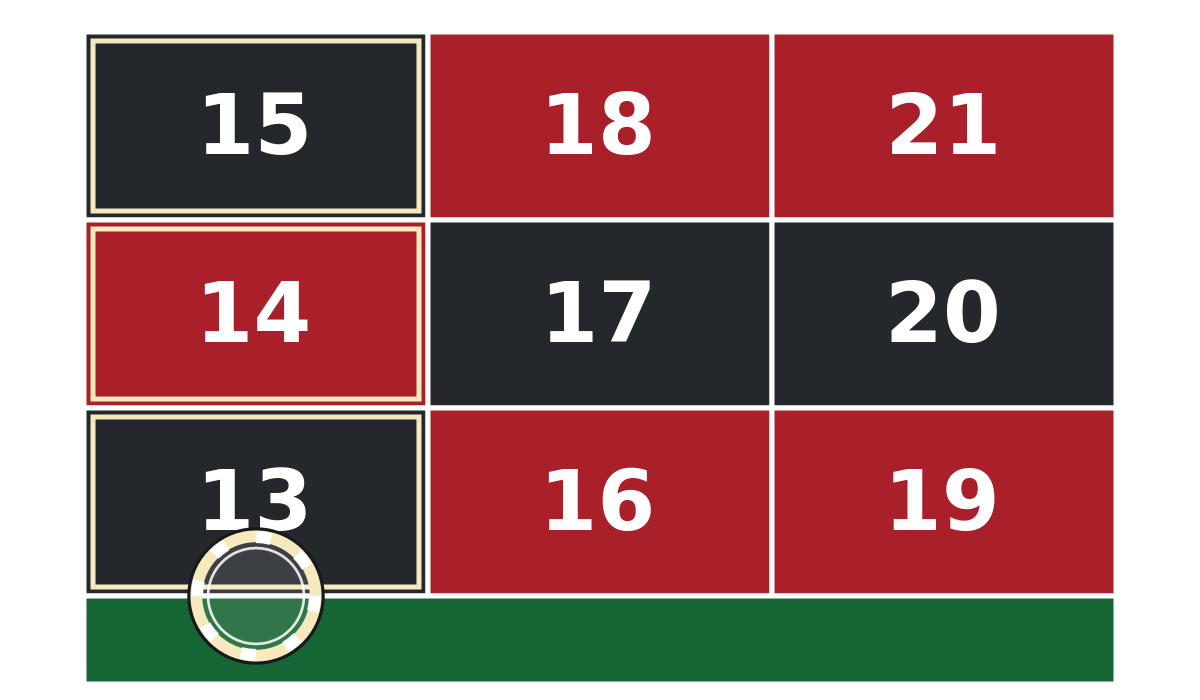
Street: three numbers
The street shown covers 13, 14 and 15. Place the chip on the outside edge below 13, halfway along that cell’s edge rather than at a corner. In this horizontal layout, the three street numbers run vertically.
Covers 13, 14 and 15. Pays 11:1; $1 returns $12.
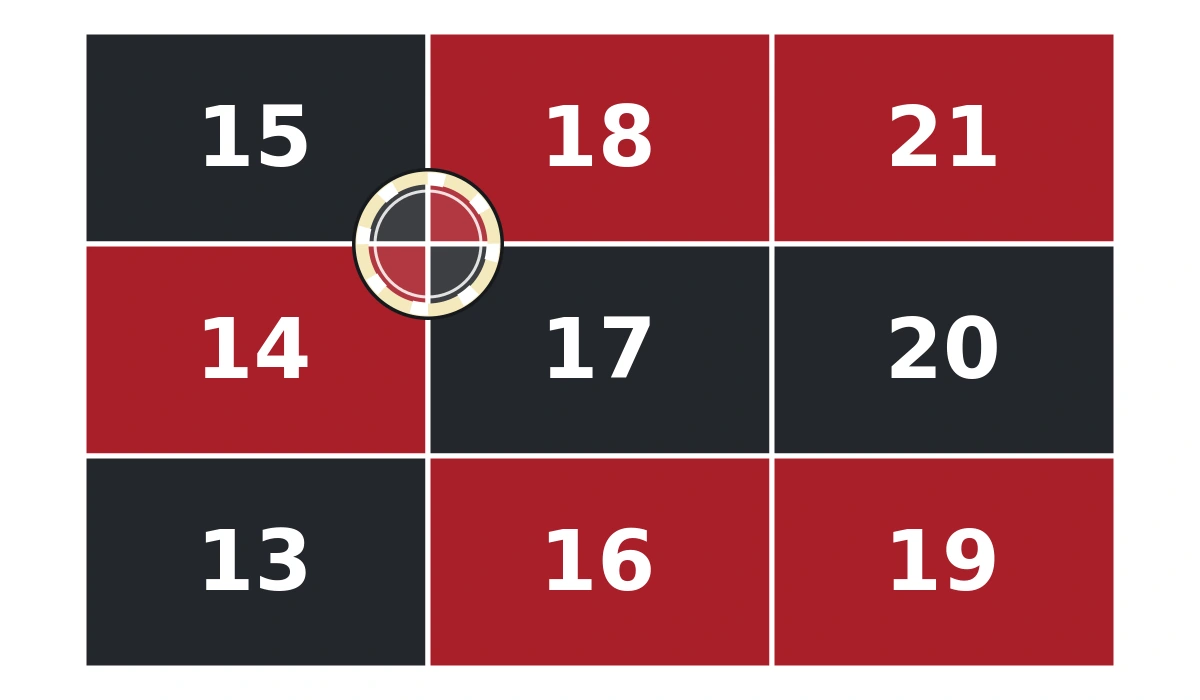
Corner: four numbers
Put the chip at the point where 14, 15, 17 and 18 meet. Each of those four numbers wins at 8:1. You cannot select any four scattered numbers and treat them as one ordinary corner bet.
Covers 14, 15, 17 and 18. $1 winning return: $9.
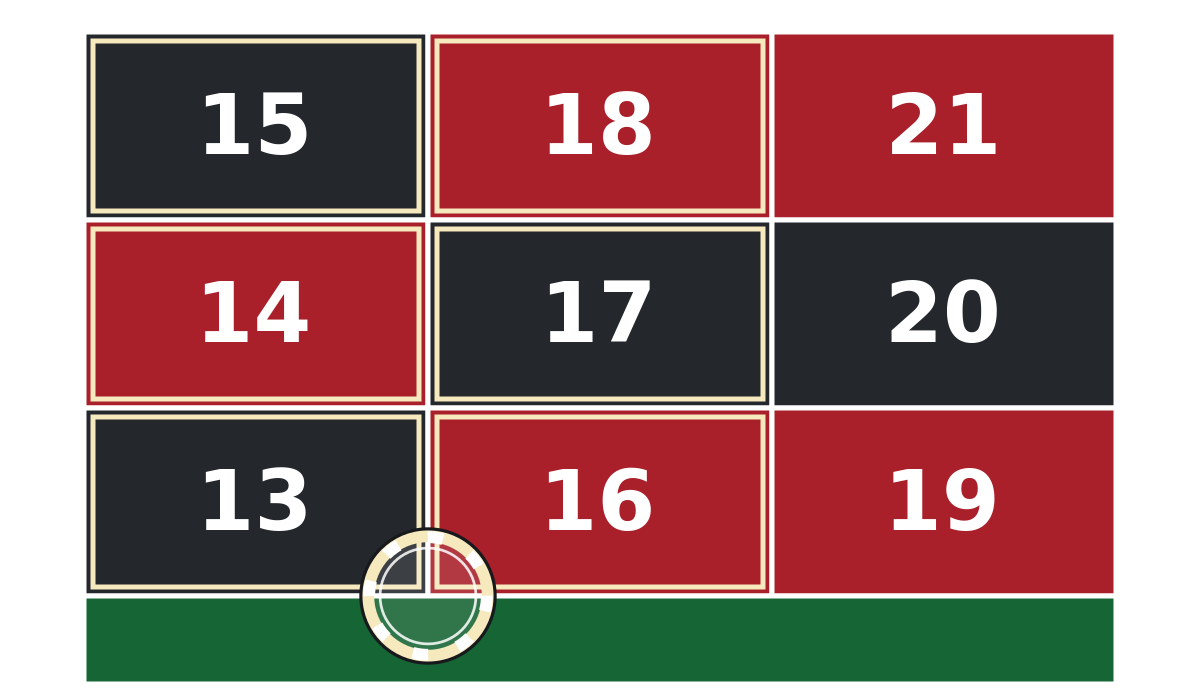
Six line: two adjacent streets
Place the chip at the outside intersection between the 13-to-15 and 16-to-18 streets. All six numbers from 13 to 18 win at 5:1. This bet is also called a double street.
Covers 13 to 18. $1 winning return: $6.
Outside bets: dozens, columns and even money
Outside bets cover larger groups using the labelled boxes around the grid. Dozens and columns cover 12 numbers each; the even-money bets cover 18. None of these standard groups includes zero or double zero.
Dozens: 1 to 12, 13 to 24 or 25 to 36
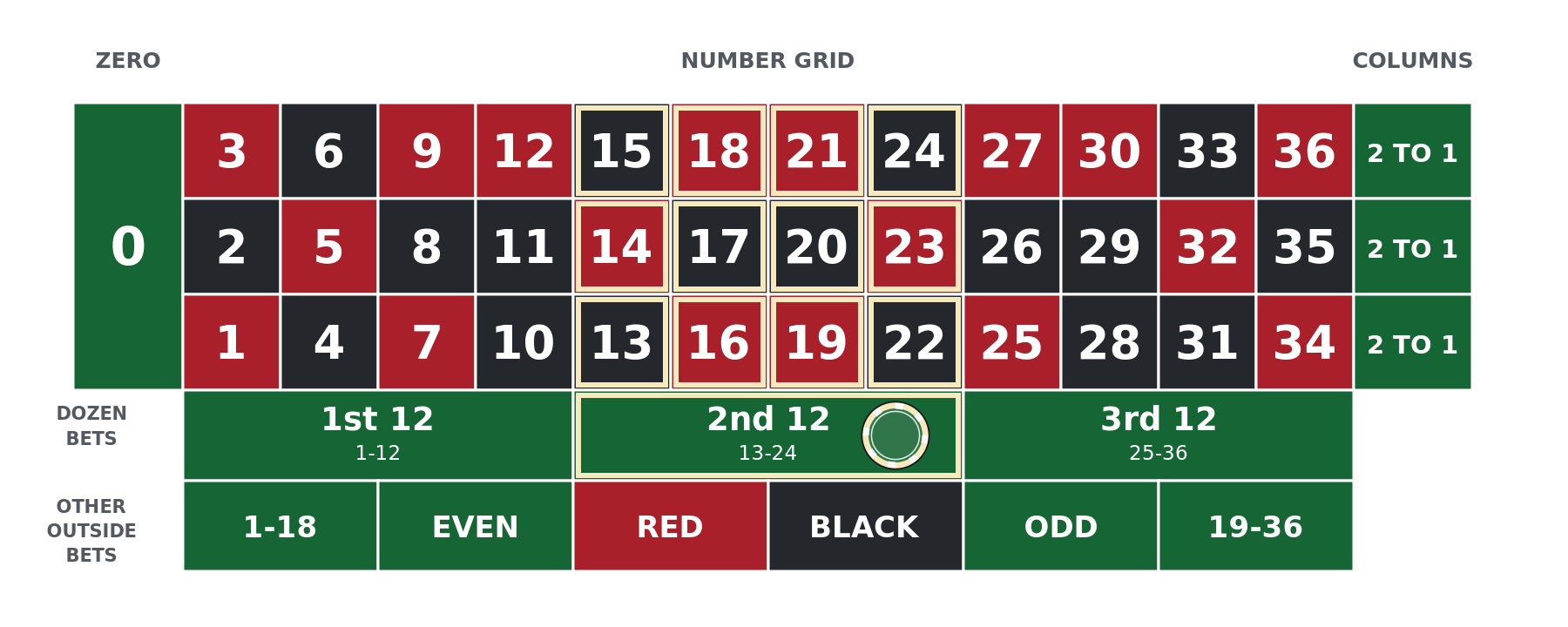
Place one chip in 1st 12, 2nd 12 or 3rd 12. The selected group pays 2:1. The example below uses the second dozen: a $5 chip returns $15 when any number from 13 to 24 lands, for $10 profit on that bet.
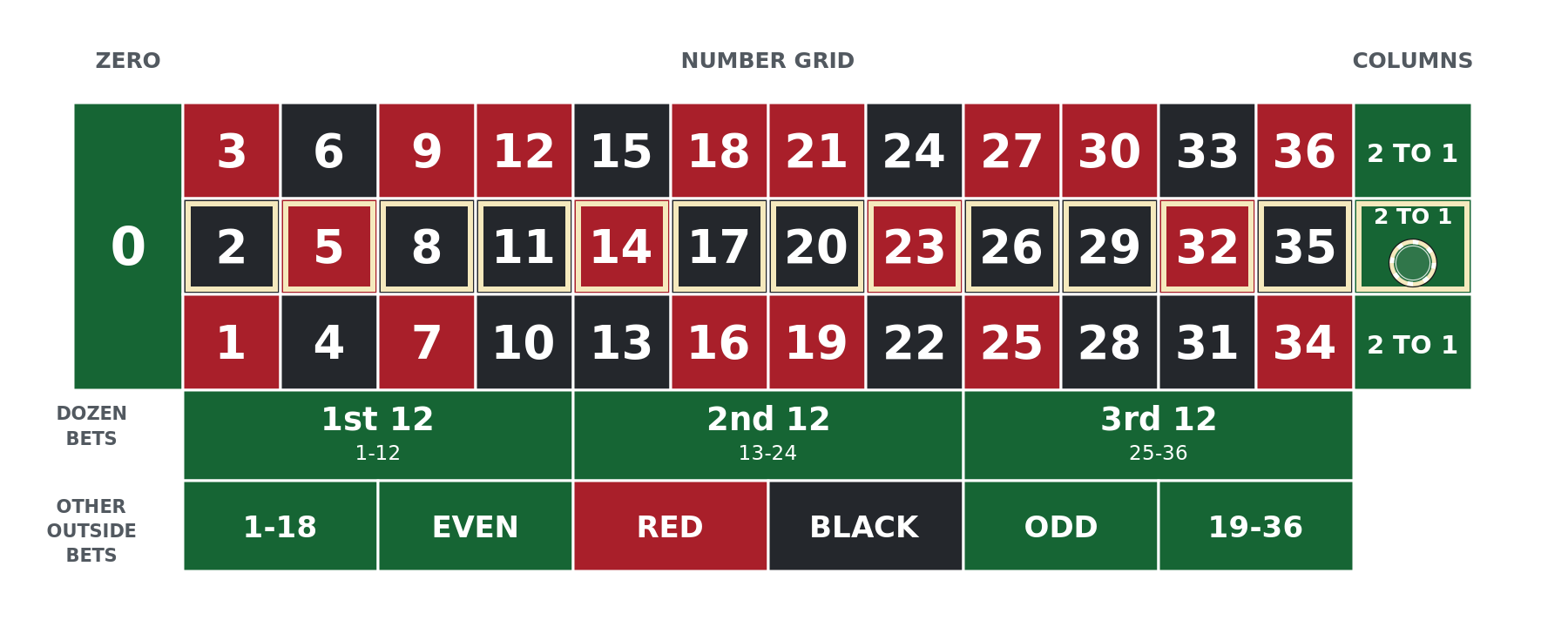
Columns: the boxes marked 2 to 1
Each column contains every third number. The middle column covers 2, 5, 8, 11, 14, 17, 20, 23, 26, 29, 32 and 35. It pays 2:1, just like a dozen, but the covered numbers are different.
Red/black, odd/even and low/high
These pay 1:1. Low covers 1 to 18 and high covers 19 to 36. A winning $10 bet makes $10 profit and returns $20. “Even money” describes the payout, not a 50% chance: zero means red wins on only 18 of 37 pockets on a single-zero wheel.
Zero is mathematically even, but it does not win the roulette Even bet. Under ordinary rules without zero protection, it loses along with the other outside bets.
Zero bets and payout exceptions
Single zero: straight, splits and first four
Betting directly on 0 pays 35:1. Where offered, a two-number zero split pays 17:1, and a three-number combination such as 0, 1 and 2 pays 11:1. The first-four bet covering 0, 1, 2 and 3 pays 8:1. Use the positions the game actually offers; zero layouts can differ.
The five-number basket on a double-zero table
This specific bet covers 0, 00, 1, 2 and 3. It pays 6:1, returning $7 on a winning $1 bet. It is not a way to choose any five numbers, and it does not belong on an ordinary single-zero layout.
At that payout, its house edge is about 7.89%, compared with 5.26% for most standard double-zero bets. The extra coverage does not make up for the lower payout.
Special zero rules and multiplier games
With La Partage on a single-zero table, zero returns half an eligible even-money stake. A $10 red bet returns $5 on zero, leaving a $5 loss. The rule reduces the house edge on those bets to about 1.35%; it does not give the same protection to dozens or inside bets.
Multiplier games can use a different ordinary straight-up payout to fund their larger hits. Side bets and jackpots have their own rules too. Read that game’s paytable rather than applying the standard chart to every roulette title.
How to calculate several bets on one spin
Total return minus total stake equals the net result. Add every winning bet’s return, including its stake, then subtract everything you put on the layout. This also accounts for the chips that lost.
Three overlapping $1 bets
Suppose you place $1 straight on 17, $1 on the 17/20 split and $1 on the 14/15/17/18 corner. The total stake is $3. This hypothetical round assumes the table permits these stakes and pays standard odds.
| Result | Return | Net result |
|---|---|---|
| 17: all three win | $63 | +$60 |
| 20: split wins | $18 | +$15 |
| 14, 15 or 18: corner wins | $9 | +$6 |
| Any other number | $0 | −$3 |
On 17, the returns are $36 + $18 + $9 = $63. Subtract the $3 stake for $60 profit. These overlapping bets cover only five different numbers, not seven: count 17 once when working out your coverage.
Two dozens: a smaller return than it first appears
Put $5 on the first dozen and $5 on the second. You have staked $10. A result from 1 to 24 makes one bet win and the other lose. The winning dozen returns $15, so your net profit is $15 − $10 = $5. A result from 25 to 36, zero or double zero loses both bets.
Use the roulette calculator to check different stakes. A message saying one bet won is not enough to tell you whether the full round made a profit.
Payout odds and winning chances are different
A standard single-zero wheel has 37 pockets; a double-zero wheel has 38. Divide the number of pockets your bet covers by the wheel’s total to find its chance of winning on a fair spin. A straight bet pays 35:1, but its chance is not 1 in 35.
| Bet coverage | Single zero | Double zero |
|---|---|---|
| 1 number: straight | 2.70% | 2.63% |
| 2 numbers: split | 5.41% | 5.26% |
| 3 numbers: street | 8.11% | 7.89% |
| 4 numbers: corner | 10.81% | 10.53% |
| 6 numbers: six line | 16.22% | 15.79% |
| 12 numbers: dozen or column | 32.43% | 31.58% |
| 18 numbers: even money | 48.65% | 47.37% |
At standard payouts without special zero rules, the common single-zero bets have the same 2.70% house edge. Most standard double-zero bets have a 5.26% edge. Betting on red instead of a number wins more often but does not lower that edge.
House edge describes the expected loss per amount wagered over many repetitions. It is not a fixed deduction from every spin, and a short session can finish far above or below that average.
Choosing stakes, table limits and bonuses
Check the minimum for the bet you want. A small chip denomination does not guarantee you can place that amount on every position. A table may require a combined inside minimum or a separate minimum on each outside bet. Our low stakes roulette guide looks at choosing tables around a smaller budget.
Changing the stake does not change the payout ratio. A $10 winning red bet still pays 1:1, just like a $1 bet. The Martingale strategy increases stakes after losses, which changes the money at risk rather than the wheel’s probabilities. Bankroll and table limits can stop the progression.
Check roulette eligibility before accepting a bonus. Look for excluded games, wagering contribution and maximum allowed bets. A slots offer is not automatically useful for roulette. The roulette bonus checks explain what to look for before opting in.
Compare the formats and casino choices in our roulette sites guide. To check an unfamiliar chip position first, use the roulette simulator or free roulette demos. Keep real-money stakes within a limit you can afford to lose; a betting system cannot remove the house edge.
Roulette bets and payouts: common questions
How much does a $1 roulette bet pay?
At standard payouts, a winning $1 straight bet returns $36, a split returns $18, a dozen or column returns $3, and an even-money bet returns $2. These totals include the original $1 stake. Subtract it to find the profit on that individual bet.
Does a 35:1 payout include my original stake?
No. The 35:1 ratio describes profit: 35 units won for every unit staked. Your winning stake is also returned. A successful $1 straight bet therefore gives $35 profit and $36 back in total.
How much does a winning $100 number bet return?
At the standard 35:1 straight-up payout, it returns $3,600: $3,500 profit plus the $100 stake. This assumes the table permits that bet and pays standard odds. Any other bets you placed must also be included when calculating the whole round.
Does a split bet pay 17:1 on each number?
A split is one bet covering two adjacent numbers. Either number wins that one stake at 17:1. A winning $1 split returns $18 in total; it does not pay separately on both numbers in the same spin.
Can several roulette bets win on the same spin?
Yes, when their coverage overlaps. A $1 straight on 17, a $1 split on 17/20 and a $1 corner on 14/15/17/18 all win if 17 lands. At standard payouts they return $63, giving $60 net profit after the $3 total stake.
What does the five-number roulette bet pay?
The double-zero basket on 0, 00, 1, 2 and 3 pays 6:1. A winning $1 bet returns $7 including the stake. Its house edge is about 7.89%, higher than the 5.26% edge on most standard double-zero bets.
Which roulette bet wins most often?
Among the common individual bets, red/black, odd/even and low/high cover the most numbers: 18 each. Each has a 48.65% chance on a single-zero wheel or 47.37% on a double-zero wheel. Their more frequent wins come with a smaller 1:1 payout, not a lower standard house edge.
Do European and American roulette pay the same?
The usual straight, split, street, corner, six-line, dozen, column and even-money payouts are the same. American roulette adds a double zero, so those bets win less often. Special zero rules, side bets and multiplier versions can change the comparison; check the actual game’s rules.
Further reading: Random Services’ roulette mathematics guide explains standard bet coverage, payouts and expected returns, including the double-zero basket exception.