How to Play Roulette: Rules and Betting Guide
Roulette is a bet on where a ball will finish on a numbered wheel. Put chips on a number, the line between numbers, or an outside bet such as red. When the result is known, each bet is settled separately according to the numbers it covers.
You do not need to learn every bet before trying a practice round. Start with the layout, the value of your chips and the total at risk. This guide shows where to place those chips, what the usual payouts mean and how to work out a round with more than one bet.
How to play a round of roulette
- Choose a table. Check the zero pockets, payout rules and minimum bet. Start in demo mode to learn the controls without staking money.
- Choose your chip value. Online, select a denomination. At a physical table, agree the value of your roulette chips with the dealer.
- Place your bets. Click or put a chip on the number, shared line or outside box you want to back.
- Check the total stake. Add every chip on the layout, not just the largest bet. That total is what you can lose this round.
- Wait for the result. On a software game, start the round when ready. At a live table, stop changing bets when betting closes.
- Check the settlement. Winning bets are paid and losing bets are collected. Decide what to place next rather than automatically repeating the last stake.
A moving wheel does not always mean betting has closed. At a live table, follow the dealer’s announcement or the on-screen betting window. Once bets are closed, leave them alone.
Understanding the roulette table
The betting layout is your map of the available wagers. Its number order is different from the order around the wheel. Two numbers must share an edge on the layout, not the wheel, to form an ordinary split bet.
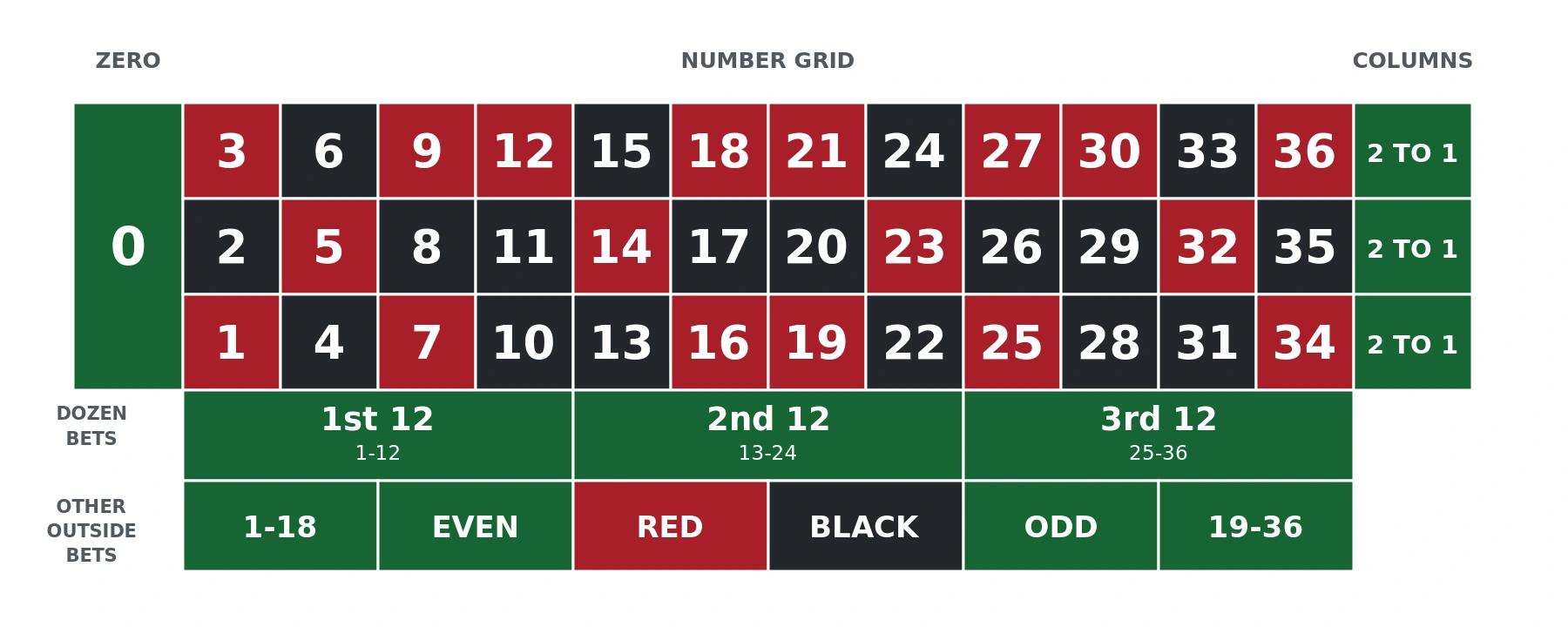
Inside bets: chips on individual numbers, shared lines or intersections. The exact position decides which numbers are covered.
Dozens: the boxes marked 1st 12, 2nd 12 and 3rd 12 cover 1 to 12, 13 to 24 and 25 to 36.
Columns: the three boxes marked 2 to 1 cover the three lines of 12 numbers. In this horizontal layout, they run across the page, not down it.
Other outside bets: red or black, odd or even, and low or high cover 18 numbers each. Zero belongs to none of those groups, and is not part of a dozen or column.
Where to put your chips
The same nine numbers appear in each closeup. Only the position of the chip changes. Each illustration shows one bet, not a combination of separate wagers.
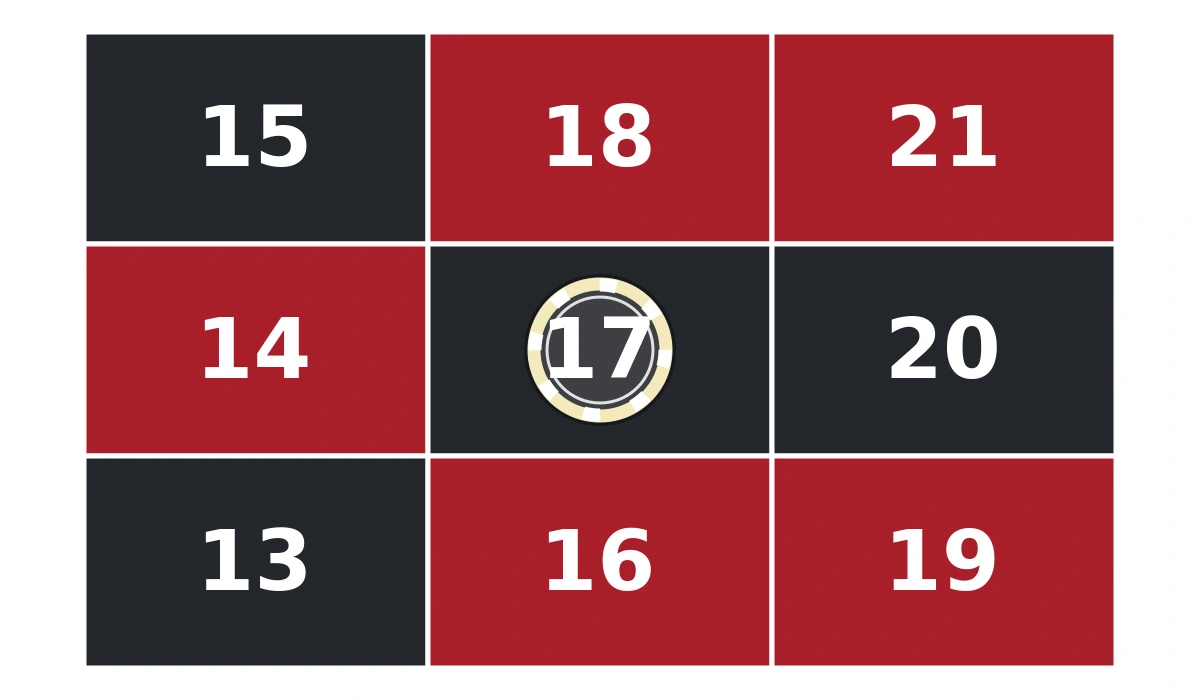
Straight bet: one number
Place the chip inside the 17 box. Only 17 wins this bet. A winning $1 chip makes $35 profit, and the original $1 comes back too.
Covers 17. Pays 35:1.
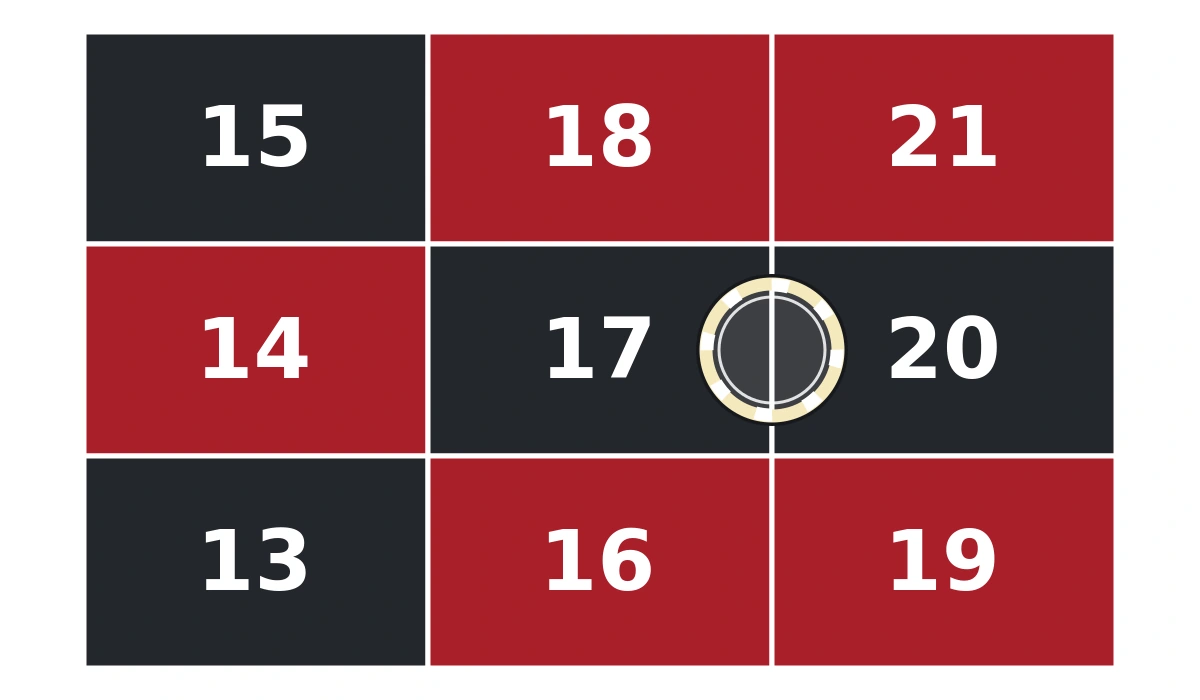
Split bet: two neighbouring numbers
Place the chip on the line between 17 and 20. Either number wins the whole bet. You are staking $1 across two numbers, not $1 on each.
Covers 17 and 20. Pays 17:1.
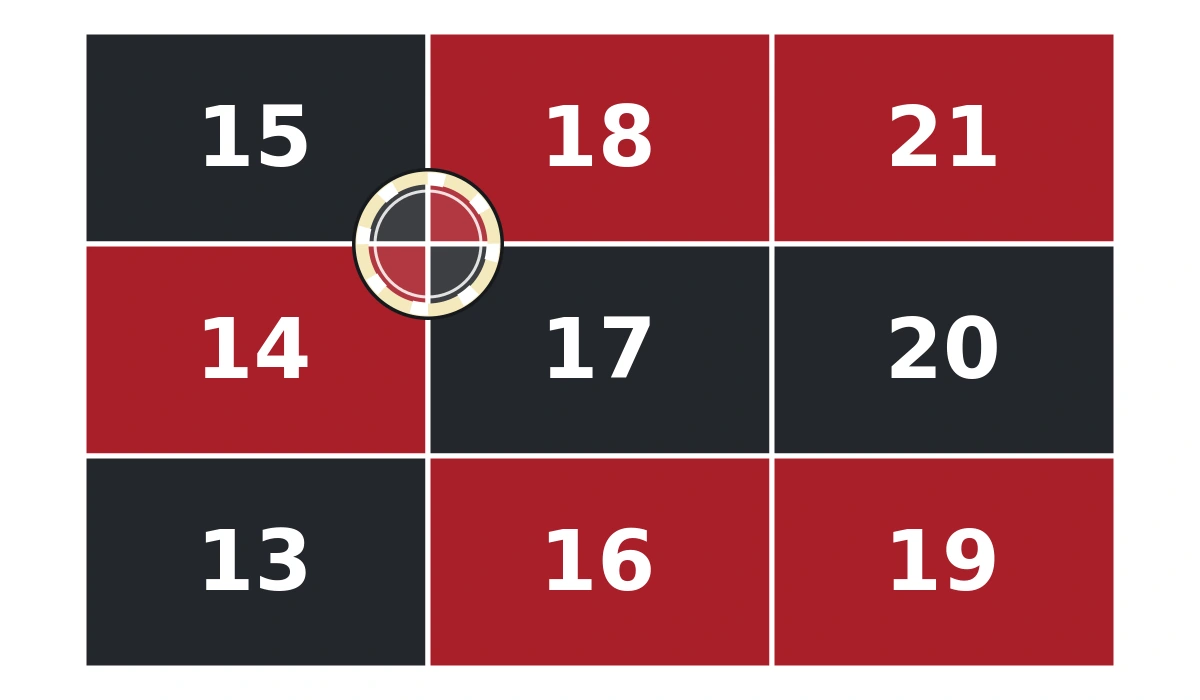
Corner bet: four numbers
Place the chip where 14, 15, 17 and 18 meet. Any of those four numbers wins. A $1 corner returns $9 in total when it hits.
Covers 14, 15, 17 and 18. Pays 8:1.
A street covers one set of three numbers, such as 13, 14 and 15. Put the chip on the outside edge of that set. A six line covers two adjacent streets, such as 13 to 18, with the chip on the outside intersection between them. Those bets pay 11:1 and 5:1 respectively.
Roulette payouts: profit versus total return
A payout of 35:1 means 35 units of profit for each unit staked. The winning stake also comes back. That makes a $1 straight bet worth $36 in total when it wins, not $35.
| Bet and coverage | Pays | Total return |
|---|---|---|
| Straight: 1 number | 35:1 | $36 |
| Split: 2 numbers | 17:1 | $18 |
| Street: 3 numbers | 11:1 | $12 |
| Corner: 4 numbers | 8:1 | $9 |
| Six line: 6 numbers | 5:1 | $6 |
| Dozen or column: 12 numbers | 2:1 | $3 |
| Red/black, odd/even, low/high: 18 numbers | 1:1 | $2 |
Returns include the winning stake. These examples do not describe multiplier roulette or optional side bets. Check the game’s payout table. The standard bet coverage and odds are also explained in Random Services’ roulette mathematics guide.
For a larger stake, multiply both the profit and the returned stake. A winning $5 red bet makes $5 profit and returns $10. A winning $2 dozen bet makes $4 profit and returns $6.
One round with two bets: a $3 example
Suppose you place $2 on the second dozen, covering 13 to 24, and $1 on number 17. Your total stake is $3. This is a hypothetical example on a table that permits those stakes and pays standard odds.
| Result | Winning bets | Return | Net |
|---|---|---|---|
| 17 | Dozen and straight | $42 | +$39 |
| 20 | Dozen only | $6 | +$3 |
| 8 or 0 | Neither bet | $0 | −$3 |
On 17, the $2 dozen returns $6 and the $1 straight returns $36. Add those returns, then subtract the full $3 stake: $42 − $3 = $39 profit. On 20, the losing $1 straight is already included when you subtract that same $3.
Use the roulette calculator to check other stakes. Always distinguish the return on a winning bet from the net result of the whole round.
Which roulette table should you choose?
For learning, choose a standard single-zero table. Usually called European roulette, it has 37 pockets: 1 to 36 and one zero. With ordinary payouts and no special zero rule, the house edge is 1/37, or about 2.70%.
A double-zero table, usually called American roulette, has 38 pockets. Most standard bets have a 2/38, or 5.26%, house edge. The usual payouts do not increase to compensate for the extra pocket. Its five-number basket on 0, 00, 1, 2 and 3 is worse still, at about 7.89%.
Red is not a 50/50 bet: it covers 18 of 37 pockets on a single-zero wheel. Choosing it rather than a straight bet changes how often you win and how much you receive, not the standard table’s house edge.
Some tables offer La Partage, which returns half an even-money stake when zero lands. Where that rule applies on a single-zero table, those bets have an edge of about 1.35%. Do not assume it applies just because the game is called French roulette. Read the rules, especially on multiplier or other special versions.
Playing online or at a physical table
Online: check the controls before the first spin
Find the chip selector, total bet display, undo control and betting limits. An extra click may add another chip rather than move the first one. Rebet restores the previous stake; a double control increases it. Check the displayed total after using either.
Software roulette lets you start your own round. Live roulette follows a dealer’s schedule, with a limited window for betting. Do not assume every game offers the same controls or needs a separate confirmation click.
Chip value is not the table minimum. A $1 chip does not necessarily mean a $1 round is allowed. Minimums can apply to the total inside stake, each outside bet or individual positions. Read the table’s limits before placing chips.
At a physical table: let the dealer finish the round
Wait for a break before buying chips. Roulette often uses a separate colour for each player, with the value agreed at the table. Stop touching bets when the dealer closes betting. Wait until settlement is finished and betting reopens before collecting or repositioning chips.
Before leaving, exchange any table-specific roulette chips for ordinary value chips. Ask the dealer when unsure; chip values and table procedures are not identical everywhere.
Three casinos with roulette tables
For real-money play, these are three options to compare. Our roulette sites guide covers the wider shortlist. Check the game rules, limits and account eligibility before depositing.

Wild Casino
Software roulette and live dealer tables in the same casino. Choose a standard game while learning, rather than starting with extra bets or unfamiliar payout rules.
Visit Casino
BetUS
The lobby lists ordinary Roulette alongside High Limit and High Roller versions. Check the ordinary table first; the different versions do not all take the same stakes.
Visit Casino
MyBookie
European, American and live roulette options. Count the zero pockets before placing chips: a familiar betting layout does not mean the odds are identical.
Visit CasinoWe may earn a commission when you join through these links.
Beginner mistakes to avoid, then a practice round
Do not confuse coverage with a prediction. A corner gives you four winning numbers, but it does not make those numbers more likely to land. Recent results do not make a number or colour due next.
Count the full stake and every losing bet. Several small chips can add up quickly. A winning number on the screen is not proof that the whole round made a profit.
Keep the first practice round simple. Use the roulette simulator to place a straight, split and corner separately. Before each spin, name the covered numbers and calculate the return. Then practise clearing the layout and changing the chip value.
The free roulette demos give you another way to learn the controls. Confirm that the game is using a practice balance. When you understand the basics, our roulette strategies guide explains betting progressions and their limits.
For money play, decide beforehand what you can afford to lose and stop at that limit. A successful practice session does not predict your next session or remove the house edge.
How to play roulette: common questions
What happens when the ball lands on zero?
On a standard table, bets on red, black, odd, even, low, high, dozens and columns lose when zero wins. A straight bet on zero wins, as does any valid combination bet that includes it. A stated rule such as La Partage can change what happens to even-money bets.
Is zero an even number in roulette?
Zero is an even number in mathematics, but roulette does not include it in the Even bet. Neither 0 nor 00 wins an Odd or Even bet.
What does a 35:1 roulette payout mean?
A winning $1 straight bet makes $35 profit and returns $36 including the original $1 stake. To calculate the result of the whole round, subtract the total you staked across all bets from everything returned.
Can I place more than one roulette bet in the same round?
Yes, subject to the table rules and limits. Each bet is settled separately. A $2 bet on the second dozen and $1 on 17 costs $3. If 17 wins at standard payouts, the two bets return $42 in total, for $39 net profit.
Does a $1 chip mean I can play a $1 round?
Not necessarily. Chip value and table minimum are different. A table may require several chips in total, a minimum on each outside bet, or a minimum on each betting position. Read that table’s limits before placing a wager.
Is single-zero roulette better than double-zero roulette?
With standard payouts and no special zero rule, single-zero roulette has a 2.70% house edge. Most standard double-zero bets have a 5.26% edge. The extra zero worsens the odds without increasing the usual payouts; neither version guarantees a winning session.
Can I bet after the roulette wheel starts spinning?
At a live table, betting can remain open after the wheel starts moving. You must stop when the dealer announces no more bets or the online betting window closes. Do not add, remove or move chips after that point.
Can I practise roulette without betting real money?
Yes. Use a simulator or a game running in demo mode to practise chip placement, changing stakes and checking returns. Confirm that you are using a practice balance. Success in a demo does not predict the results of later real-money play.
Further reading: Roulette probabilities and expected returns, from Random Services, explains the mathematics of standard bets, including the double-zero basket exception.